Welcome to the kAI Lab!
We choose to go to the moon. We choose to go to the moon in this decade and do the other things, not because they are easy, but because they are hard, because that goal will serve to organize and measure the best of our energies and skills, because that challenge is one that we are willing to accept, one we are unwilling to postpone, and one which we intend to win, and the others, too. — John F. Kennedy
The kAI Lab, led by Dr. Kaiqun Fu, focuses on advancing artificial intelligence, data mining, and machine learning techniques for analyzing complex spatiotemporal systems. kAI lab develops innovative computational models and algorithms to tackle real-world challenges in transportation, public safety, environmental monitoring, and socio-economic systems.
Urban computing is experiencing an increasing amount of attention. Modern urban computing is an interdisciplinary study in which critical urban issues are studied using state-of-the-art computing technologies such as spatial data mining and machine learning. My research interests span the areas of urban computing: spatiotemporal data mining, GeoAI, social media analysis, and machine learning's application in spatiotemporal event forecasting. My studies can bring value to a wide range of crucial domains, such as social event detection and monitoring, transportation-related incident detection and impact prediction, urban safety perception, and various spatiotemporal-related interdisciplinary applications.
Active Grants
-
NASA
Time series multi-modal foundation model for near-real-time land surface dynamics characterization
in support of ESDT,
Role: Co-PI
Sponsored by: National Aeronautics & Space Administration (NASA), PI – Hankui Zhang, Co-PI - Xiaoyang Zhang; Grant No. 23-AIST23-0106, Jun. 1, 2025 to May 31, 2027
Amount: $462,516 -
NSF
EAGER: PBI: Collaboration Patterns and Socio-Economic Impacts Analysis in Emerging Science and
Technology with Machine Learning Algorithms,
Role: PI
Sponsored by: National Science Foundation (NSF), Co-PIs – Taoran Ji, Grant No. NSF-2431845, Sep. 1, 2024 to Aug. 31, 2026
Amount: $300,000 -
SDSU
Spatiotemporal Graph Attention Network for Location Representation Learning,
Role: PI
Sponsored by: SDSU Office of Academic Affairs and Office of Research and Economic Development: Research, Scholarship and Creative Activity (RSCA) Challenge Fund FY2025, Co-PIs – Hankui Zhang, May 1, 2025 to Aug. 31, 2025
Amount: $10,118 -
NSF
CRII: IIS: III: Learning Spatiotemporal Impacts of Text-enriched Traffic Events with Injection of
Interpretability from Graph Neural Networks and Physics-Informed Machine Learning,
Role: Sole PI
Sponsored by: National Science Foundation (NSF), Grant No. NSF-2348443, Aug. 1, 2024 to Jul. 31, 2026
Amount: $174,734 -
NSF
Collaborative Research: RII Track-2 FEC: STORM: Data-Driven Approaches for Secure Electric Grids in
Communities Disproportionately Impacted by Climate Change,
Role: Senior Personnel
Sponsored by: National Science Foundation (NSF), PI – Tim Hansen, Senior Personnel – Hossein Moradi, Kwanghee Won, Michael Puthawala, Mostafa Tazarv, Jeffrey Doom, and Aritra Banerjee, Grant No. NSF-2316400, Sep. 15, 2023 to Aug. 31, 2027,
Amount: $750,000
Past Grants
-
SDSU
Analyzing Deaths of Despair Determinants in Rural Areas with Spatiotemporal Considerations,
Role: Co-PI
Sponsored by: SDSU Office of Academic Affairs and Office of Research and Economic Development: Seeding Partnerships to Advance Research Collaborations (SPARC) Challenge Fund FY2023, Jul. 1, 2023 to Jun. 30, 2024,
Amount: $12,000. -
SDSU
Design of Neural Ordinary Differential Equations for Increasing Electricity Grid
Resilience,
Role: Co-PI
Sponsored by: SDSU Office of Academic Affairs and Office of Research and Economic Development: Research, Scholarship and Creative Activity (RSCA) Challenge Fund FY2022, PI – Tim Hansen, Jul. 1, 2022 to Jun. 30, 2023,
Amount: $12,468.
Projects
Learning Spatiotemporal Impacts of Traffic Events with Injection of Interpretability from Graph Neural Networks and Physics-Informed Machine Learning
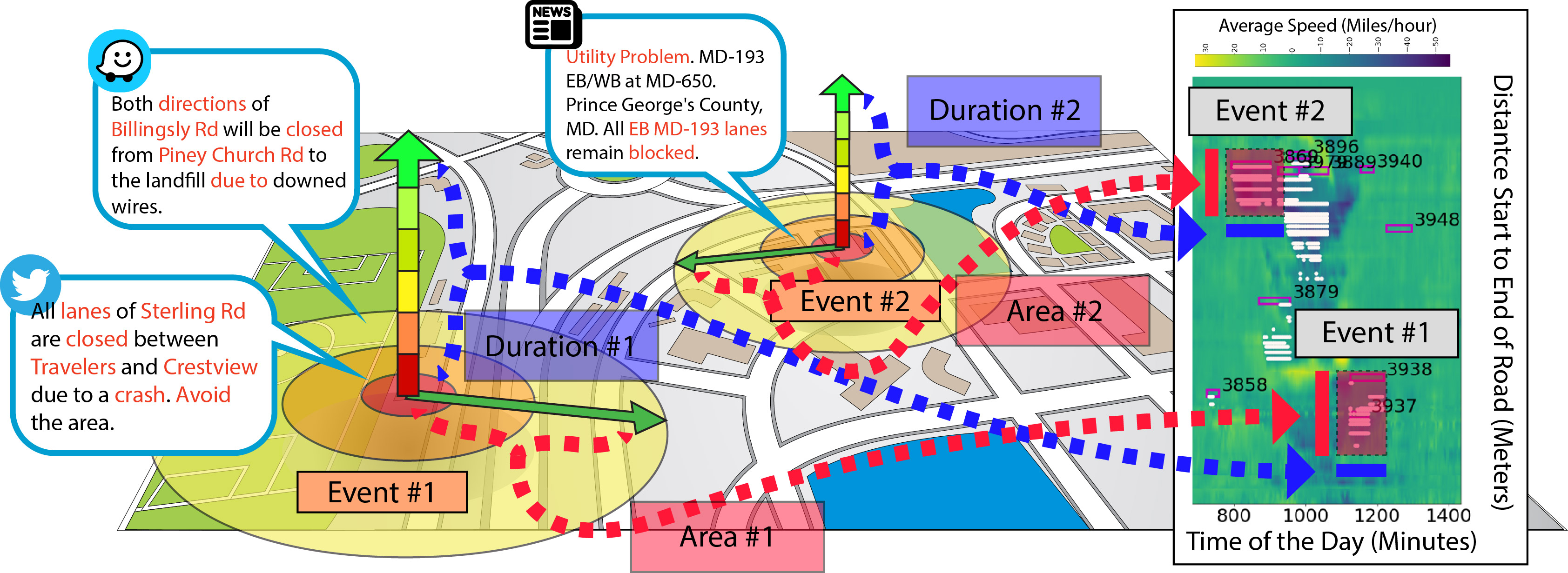
This project will develop 1) a novel multimodal representation learning approach combining machine learning and graph mining to learn the text-enriched embedding of the traffic events from heterogenous social/news media and Intelligent Transportation System (ITS) networks, 2) novel spatiotemporal data mining and transformer-based graph neural network methods to detect transportation events and their cascading impacts on heterogeneous ITS networks, 3) a new physicsinformed machine learning solution to model the cascading impacts with the Korteweg-de Vries (KdV ) equation and inject model interpretability while forecasting the traffic events in specific scenarios. These advancements will make significant contributions to the fields of explainable graph mining, physics-informed machine learning, and spatiotemporal event analysis. The expected outcomes will enrich our understanding of the nature of traffic events in complex ITS networks. The methodologies developed could revolutionize other research areas, offering a fresh perspective on spatiotemporal event analysis and paving the way for more data-efficient Artificial Intelligence applications across various Cyber-Physical Systems landscapes.

Collaboration Patterns and Socio-Economic Impacts Analysis in Emerging Science and Technology with Machine Learning Algorithms
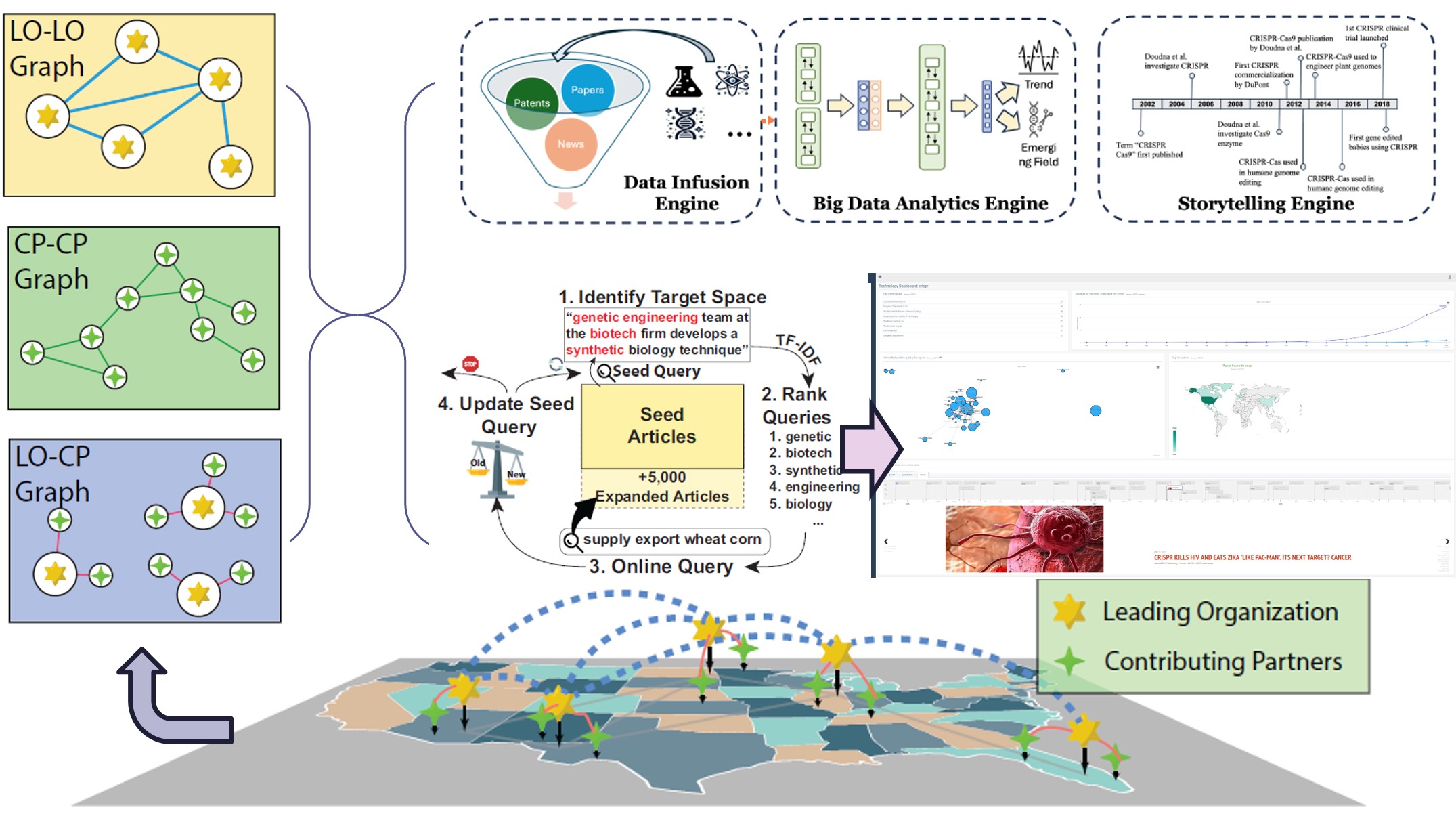
This proposal encompasses three primary initiatives: 1) Forecasting Emergence in Science and Technology (S&T) Areas Using Multimodal Machine Learning: This involves leveraging machine learning to assess the potential of various technology areas evolving from earlystage experimental concepts to transformative research products with wide-ranging applications. 2) Evaluating the Societal and Economic Impact of Leading Research Organizations Regionally with Deep Graph Neural Networks: Utilizing geolocation data and historical research collaboration records, this objective introduces an innovative approach using graph neural networks. This method aims to model the science and technology trends of leading organizations and their societal and economic impacts at regional and national levels. 3) A Data-Driven Hybrid Approach to Monitor Workforce Development Demographics: This proposal suggests combining interactive, data-driven methods with traditional data collection techniques to track the career development of individuals involved in these technology areas. The research goals outlined in this proposal are inherently interdisciplinary, requiring seamless collaboration among Computer Scientists, Sociologists, and Economists. The developed technical approaches will make significant research contributions to the fields of spatial data mining, graph neural networks and S&T trends and impact predictions and beneficial in light of the recent NSF Engines initiative.
Time series multi-modal foundation model for near-real-time land surface dynamics characterization in support of ESDT
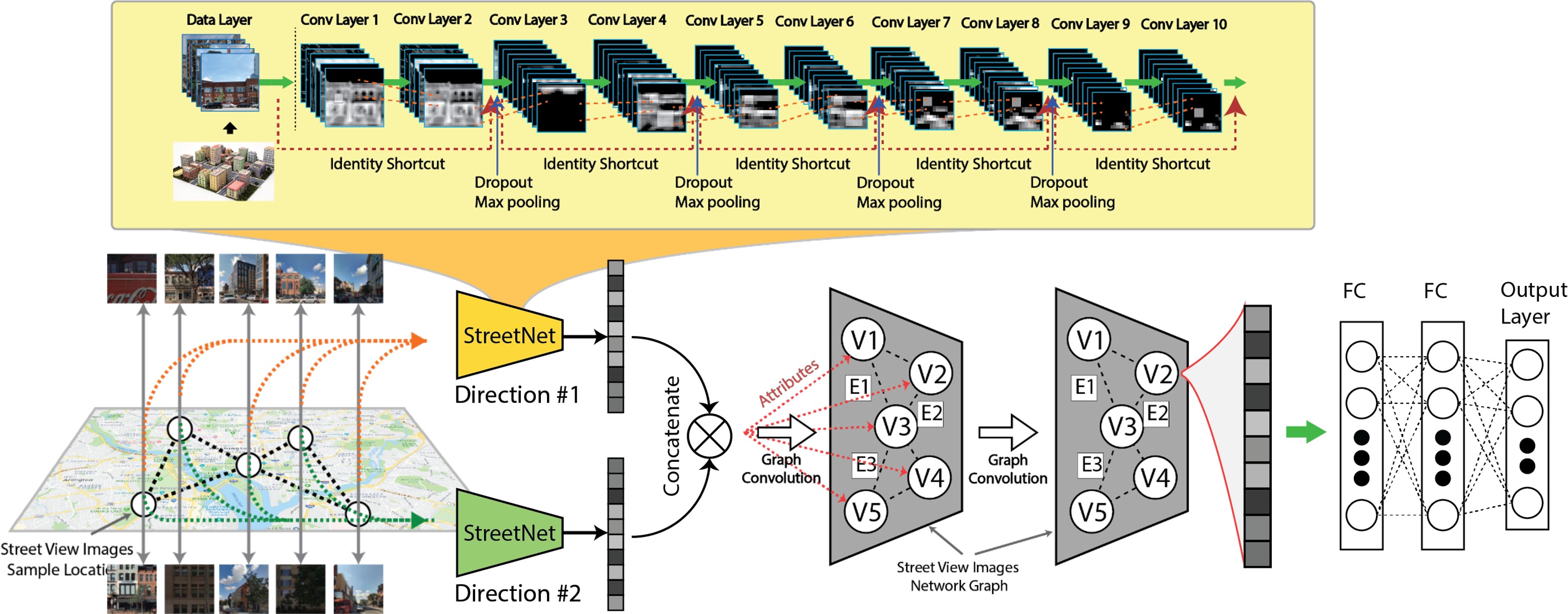
The objectives of this project are to (i) develop a foundation model to fuse time series multi-modal data; (ii) fine-tune the foundation model for mapping soil moisture, fuel moisture content, and fuel load in near-real-time and for any satellite data acquisition dates; and (iii) explain the foundation and fine-tuned models to identify model improvement requirement. The multi-modal data include HLS multi-spectral reflectance, Sentinel-1A to -1C C-band SAR and NISAR L-band SAR, and data. The project will deliver the training data, the trained foundation models, fine-tuned models for soil moisture, fuel moisture content, and fuel load retrieval, and the developed software and codes. The algorithms will be quasi-operational, i.e., ready-to-use to operationally generate surface parameters when deployed in a system which can access these multi-modal data in near-real-time. The models will be built using data across the conterminous United States (CONUS) and expected to work anywhere anytime in CONUS. In addition, the project will analyze and understand the uncertainty of the retrieved parameters and its sensitivity to model size, training sample size by understanding and interpreting the developed models.